I have had a quasi-nemesis in my life, a public intellectual who is prominent and popular, a common reference for many people, on issues as varied as fast food to psychedelics. I don’t strictly and oppositely disagree with his works as a public intellectual, but they’ve always been an anchor to imaginations, a palliative comfort for people. He has crafted a career out of simplifying and “clarifying” complex issues that confront the well-to-do consumer’s life, and (I would argue) give them a softer and less challenging hue. He will consider a topic that raises questions about the broader politics of the world, and a path of further inquiry, a truly romantic quest for meaning, and turn that path into a cul-de-sac for someone who still has a print magazine subscription. My quasi-nemesis has no idea I exist, but he’s haunted my workplaces and conversations for years. His name is Michael Pollan, and if you are an American who’s had thoughts about modern food in the 21st century, of course you’ve heard of him.
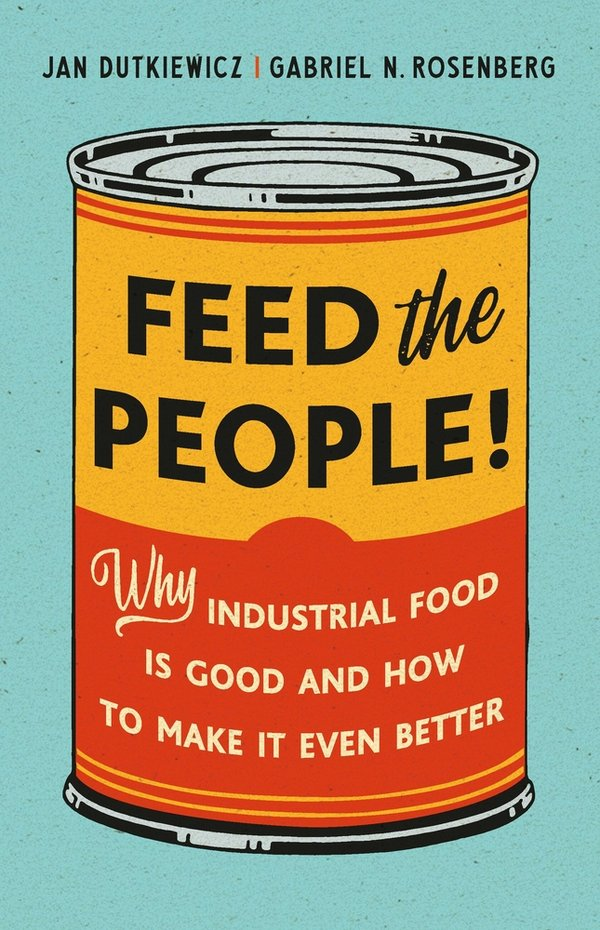
So, in at least one way, I am a completely partisan reviewer of Feed The People!, by Jan Dutkiewicz and Gabriel N. Rosenberg, a book that is a broad retort against the American Foodie ideology that has arisen in the wake of The Omnivore’s Dilemma, Whole Foods, myriad bougie grocery brands, chef-driven concepts, home cooking, farming, and food policy movements. This book was made for me. It tries to earnestly consider the vast array of systems that produce modern food, and weigh the benefits and the costs in a more honest manner. It’s making the bold attempt to try and be realistic about food, rather than idealistic. In many ways, it successfully accomplishes a more realistic description of modern food systems. In some notable ways, it remains idealistic about the solutions.
—
FTP! presents an openly contrarian take to the typical American Foodie opinions of the 21st century. In contrast to the gauzy and romantic idealism of locavores and farm-to-table food magazines and influencers, or the permacrisis of activists (and consumers and politicians) who say that “American food is broken”, Dutkiewicz and Rosenberg introduce food systems analysis to the reader, and urge a more grounded and informed understanding of how food ends up on our plates.
Using brash examples like Waffle House and Walmart, the authors point out that industrial food has developed abundance that any other age in human history would find beyond comprehension. From the efficiency of modern crop sciences to the diverse bounties of today’s grocery aisles, FTP! wants the reader to move beyond the discontent of food snobs, and earnestly appreciate what technology has enabled humanity to produce. The authors also want to highlight what they believe are actual problems within modern food, and redirect people’s attention to pressing inequalities and resource use within food production, and away from chasing Michael Pollan-fueled fantasies to farms that never were.
The book is oriented around five major areas within food– Farms, Meat, Food Access/School Lunches, Food Workers, and Processed Food. Each receives a chapter of extensive and grounded analysis of the dynamics working to create the status quo– landed gentry farmers, industrial meat, agribusiness, lunch ladies, and many other actors make an appearance. No chapter is exclusively praise or prophetic doom. This book is anti-apocalyptic, and the authors clearly wish to inform people, rather than agitate them.
—
As a cathartic experience, FTP! absolutely delivers. There are numerous passages and analysis that are a delightful counterpunch to Foodie Idealism– yes, the dream of “local food” often times puts many well-meaning producers into an impossible problem, of growing food on land that is, by definition, some of the most expensive acreage available (just outside blue/liberal cities). But more than catharsis, the book tries to reframe the questions to actual problems in food. Genetically modified seeds can be a net positive to food and the earth. They aren’t the problem. The issue related to GMOs is that they are often used to make environmentally-damaging pesticide use easier for producers. The Foodie Discourse is positively teeming with this kind of poor thinking, and FTP! makes big strides towards rebutting the noise.
FTP! also successfully lands the double-punch of “postive, and negative” about food, over and over again. In contrast to a lot of euphoric Foodie discourse, Dutikiewicz strive to keep both positives and negatives in their readers’ minds. Yes, a Waffle House waffle is a marvel of technology and infrastructure, but also… Waffle House workers have difficult or miserable working conditions. Modern farms are more efficient than almost any land in history, but also….farmworkers have minimal protections, even in blue states.
Yet, for a book that is so thorough in its coverage of the marvels and miseries of food, and the title’s promise of how to improve industrial systems, the solutions are sometimes a let down. The moments where the book finally does pivot to actual power in US food, and where the real problems are sourced from– it becomes a shocking transition to vague and broad strokes. After pages running through the types of modern farmers, the praise of the green agricultural revolution and the true promise of seed technologies (GMOs can be cool), it’s a harsh note to suddenly have the prescription be “We should address the incentives that undergird the model of Bayer and the most successful 5% of US farmers, including implementing penalties for Clean Water Act violations and scrapping ethanol fuel requirements”. If only it were that easy!
Reading FTP! gave me a number of opportunities to mutter “if only it were that easy!” at the solutions that were suggested. Not that any of the proffered policy ideas were wrong, but they seemed to sorely underplay the power dynamics involved in making their specific policy changes. To riff off a meme, one does not simply undergird the models of Bayer and Big Farmers– those are some of the most entrenched political powers in the nation. Labor unions are absolutely an essential tool for improving the lives of farmworkers and foodworkers, but those unions are the fruit of some of the most difficult political labor in modern life, and constantly under threat and attack. The solutions that Dutkiewicz and Rosenberg suggest are not the options for a technocratic society, they are the goals of a nationwide social democracy or democratic socialist state. I can understand why the authors would not want to underline the “political coalition” challenges in a book on industrial food, but it’s the…realistic… analysis.
Even though there’s some avowed tension between FTP! and the crunchy crowd, I think there’s still room for unity. For as much as the book likes to ping Wendell Berry for his romantic notions of farm life, and the errors that Berry’s poetic criticism might have inspired, I think the authors and Wendell Berry are more in agreement than either side might imagine. What both parties are interested in is having people attend to food– to pay attention to it, to understand it, and a belief that understanding how food is made will be good for the reader and better for food production, and for improving it. Also, as a retired animal rights activist who’s read dozens of books on food, in the interest of being honest, I have to say: FTP! is a “vegetarian” book, if a bit clandestinely. The chapter on meat lays out the impacts from the industries, and (spoiler) the industries don’t come out looking very good. This is my armchair analysis, but one of the reasons why the authors might have written the book is because, in fact, lots of good vegetarian options come from industrial food systems, and many of them qualify as “processed foods.” A defense of that world is needed in a discourse sphere of “raise your own chickens” silliness.
I think the book deserves close reading, rather than breezing through, in part because the details and solutions deserve close thought. For example, I think the authors might be presuming a little too-much stability into the modern food systems. The resource draws that have enabled the modern boom in food are not sustainable for the planet. The authors acknowledge it broadly (and in relation to meat), but the tone of the book is one that often puts the resource challenge as a “fix” to a system that (in my opinion) needs to “turn”. Also, for being a contrarian text, the book will say the contrarian part loud, but then follow up with a quieter “actually some of the Foodie critique is confirmed by research”. As one example, the authors denounce the stigma and bad thinking that the terms “processed foods” or “ultraprocessed foods” have created in food discourse, and it is a much needed corrective to the bullshit. But then a few paragraphs later they do admit that the terms, along with “hyperpalatability”, still have a valid use for food research and taxonomy of food types, and they agree with the (very confirmed) research showing that diets that are majority ultraprocessed foods are correlated with increased negative health outcomes.
—
This is a book for people who are foodies, and for people who are irritated by foodies. It is for people who might only know in vague terms why Food has gotten better, and would like some better information to rebut a snobby food person in their lives. The contrarian angle is refreshing for an age that is full of self-congratulatory and self-centered food consumption, and it was genuinely relieving to see some hard facts about food be stated plainly– “farmer” is just a label we use for a particular relationship to the land, namely “ownership”.
If there’s one group of folks who I’d really like to read the book, it would probably be elected Democrats and their staffers, but (keeping it real) that too is an incredibly idealistic goal– the halls of DC are walked by people who understand the power dynamics at play in food, they aren’t looking to rapidly shift power. But the sections de-romanticizing “farmers” would be a boon in itself.
But it is not a book for people looking to be assuaged in their current patterns and relationships with food, and for that the authors deserve some credit. It is far easier in this world to strike a simplistic “pro-technology” or “anti-technology” stance, and avoid the complexities that either side would deny. Dutkiewicz and Rosenberg don’t shy away from the problems or the successes of modern industrial food, nor should any of us.